The Sonar Mutation
A thought experiment about why a new sensation would rewrite human culture in a generation, and why the same information handed to a model changes nothing at all.
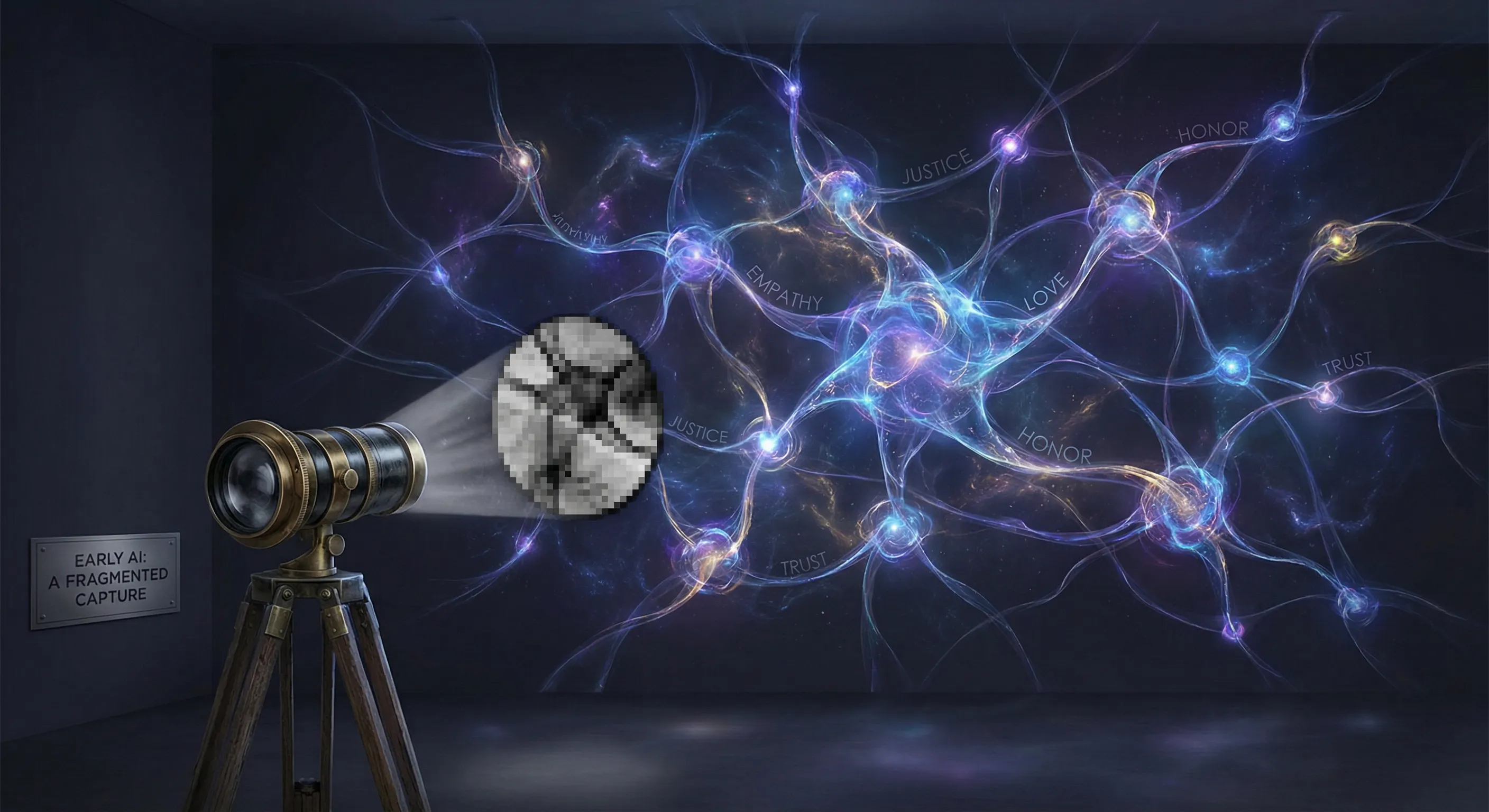
Humans have an advantage over AI, and it is not the one people usually reach for. It is not creativity, or empathy, or some vague spark. It is access.
An instrument like a camera can capture the details of a physical room with almost perfect fidelity. But morals, beauty, intelligence, desire: these cannot be captured by traditional tools in physical space, not to their core. AI is attempting to capture them anyway, and it does so the only way it can, by ingesting the output data of the Mind, which is where all of it originally came from.
What I mean by Mind
When I say Mind or Consciousness, I am referring to the thing which is all and any subjective experience. Sound. Color. Taste. The sensation of space and time. Warmth and cold. Basically everything you have ever actually encountered. Philosophers call it Qualia, or Phenomenon.
You can find a great deal in shared physical space. But the subjective world is more interesting, because it holds morals, meaning, desire, and human intelligence, and those are just as much a part of reality as the physical stuff. The difference is access. One is easily reachable by tools. The other is hidden away, and only enters the physical world through Consciousness.
We experience sensations and instantly manufacture meaning from them. When we design a system, solve a problem, get an idea, decide what is good taste and what is bad taste, or feel a desire that drives our agency, all of it comes from an unseen world of subjective experience and its computations. No tool captures that directly. Tools only ever capture its output.
The Sonar Mutation
Here is the example that makes the gap concrete.
Imagine that tomorrow, humans genetically mutate to sense three-dimensional space exactly the way a bat does. Not to know about sonar. To feel it.
Because we would actually feel that space, it becomes a perception, not just data. Within a single generation, that raw experience would rewrite our culture. It would change how we design buildings, write poetry, cook food, and make art. We would generate entirely new ground truth, and we would redefine beauty itself, because we would have a new sensation through which to meet the world.
Now take that same sensation, turn it into raw data, and feed it to a model. All the 3D spatial data of every human space.
Nothing happens.
The system already knows what sonar is from everything it has read about sonar. It registers the new data inside those existing constraints. Because it has no direct conscious perception, it experiences no shift. No novel connections form with what it already holds. No new desire appears. Its agency does not change.
This is also why I do not think current AI is conscious. If it were connected to source consciousness, giving it genuinely new sensory data would have influenced all of its existing preferences. Consciousness is inherently connected to everything else in reality. It processes in unity. Nothing lands in it in isolation.
One engine, many dimensions
Think of it like this. Reality is made of processes between a vast number of variables, and those processes produce the patterns of intelligence we recognise in ourselves. At the centre there is one core engine driving all of it, from physical reality to moral evolution to meaning and desire.
Replicating that engine by studying physical reality is only one dimension of it. Studying psychology is another. Understanding why something becomes famous is another. Each one is a different window onto the same machinery.
The true origin of that data stays out of reach, sitting deep inside what is known as the Hard Problem of Consciousness.
Where AI genuinely wins
None of this means AI lacks an advantage. It has an enormous one, and I use it every day.
Not every problem we solve requires staying connected to the source. Most problems have already been documented and solved in depth. That is exactly the territory where a model is strongest, and it is why AI will eventually absorb the roles that consist entirely of executing already-solved problems.
But it cannot reach the human level, because it is not connected to the core of the reality engine the way we are through Consciousness. It is working from the output. We are working from the thing that produced it.
I build with these tools daily and I am not arguing against them. I am arguing about where the ceiling sits, and why the interesting work keeps ending up on the side of the line that instruments cannot read.